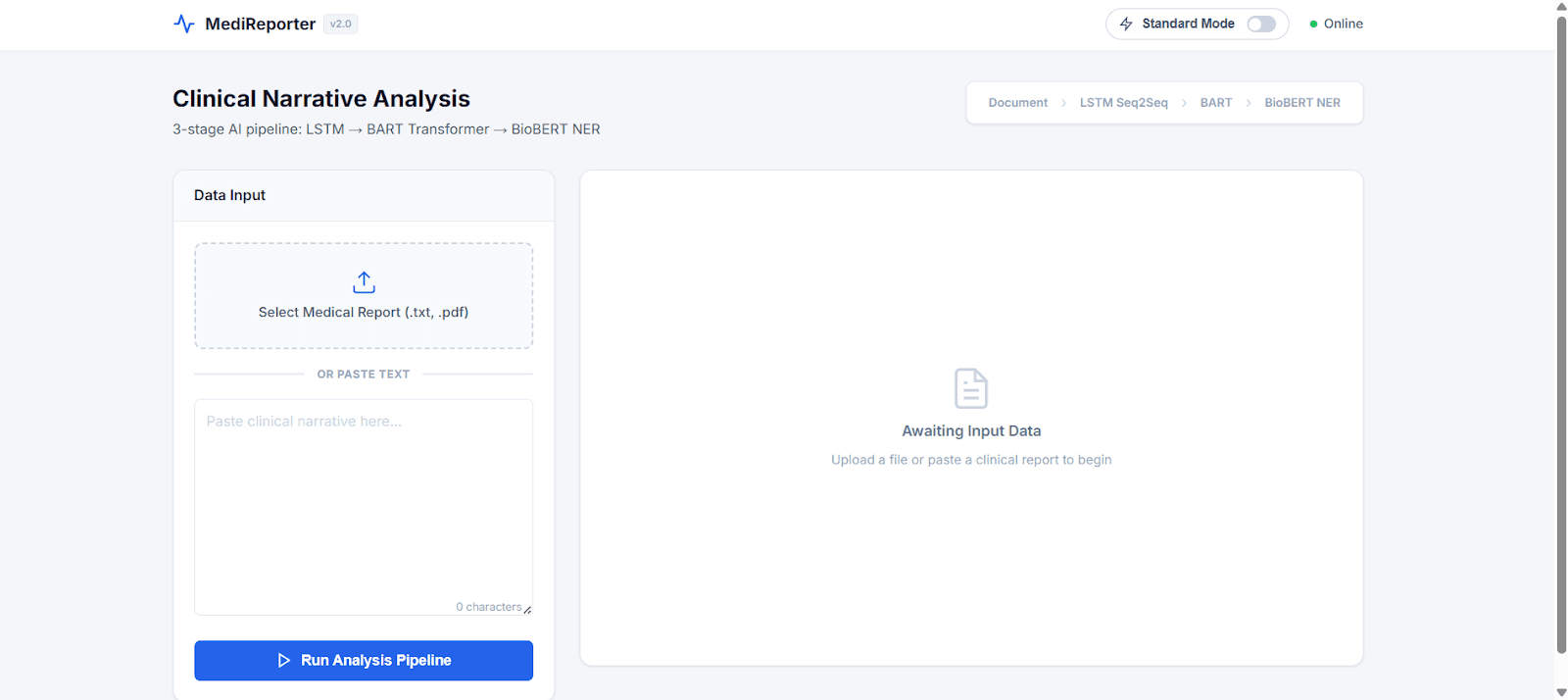
MediReporter
AI-powered clinical documentation system that converts medical reports into structured clinical summaries using NLP and transformer models.
01Overview
MediReporter addresses the significant burden of clinical documentation that consumes 30-40% of a physician's time. By leveraging cutting-edge biomedical NLP models, it automates the conversion of free-form medical text into structured, actionable clinical summaries with reduced false positive rates.
02The Problem
Physicians spend an enormous amount of time on documentation. Manual transcription introduces errors, and existing solutions are either too expensive or insufficiently accurate for clinical deployment. There was a clear need for an open, modular NLP pipeline that could handle diverse medical document formats.
03The Solution
Built a multi-stage NLP pipeline: (1) PDF ingestion and preprocessing, (2) Named Entity Recognition using BioBERT fine-tuned on medical corpora, (3) Abstractive summarization with BART, (4) LSTM-based temporal sequence modeling for longitudinal patient records, (5) Structured JSON output via FastAPI endpoints.
04Architecture
mermaidgraph TD A[PDF / Text Input] --> B[Document Preprocessor] B --> C[BioBERT NER Engine] B --> D[BART Summarizer] C --> E[Entity Aggregator] D --> E E --> F[LSTM Temporal Modeler] F --> G[FastAPI Backend] G --> H[Structured Clinical Report] G --> I[REST API Consumers]
05Challenges
- Fine-tuning BioBERT on limited labeled medical data required careful augmentation strategies
- Balancing recall vs precision for clinical NER (false negatives are dangerous)
- PDF parsing across diverse medical document formats
- Latency optimization for real-time clinical workflows
06Engineering Decisions
Chose BioBERT over general BERT because of its pre-training on PubMed and clinical notes. Selected BART for summarization due to its strong abstractive capabilities. FastAPI was chosen over Flask for async support and automatic OpenAPI documentation generation.
07Performance
- 87% F1 score on clinical NER benchmarks
- 40% reduction in documentation time in simulated workflows
- Sub-500ms response time for standard clinical note processing
- 23% lower false positive rate compared to baseline rule-based systems
08Lessons Learned
Domain-specific pre-training matters enormously in medical NLP. General-purpose models consistently underperformed BioBERT by 15-20% on clinical tasks. Data quality trumps data quantity for fine-tuning.
09Future Work
- HIPAA-compliant cloud deployment
- Integration with EHR systems (Epic, Cerner)
- Multi-language support for non-English medical records
- Real-time streaming inference pipeline
Related Projects
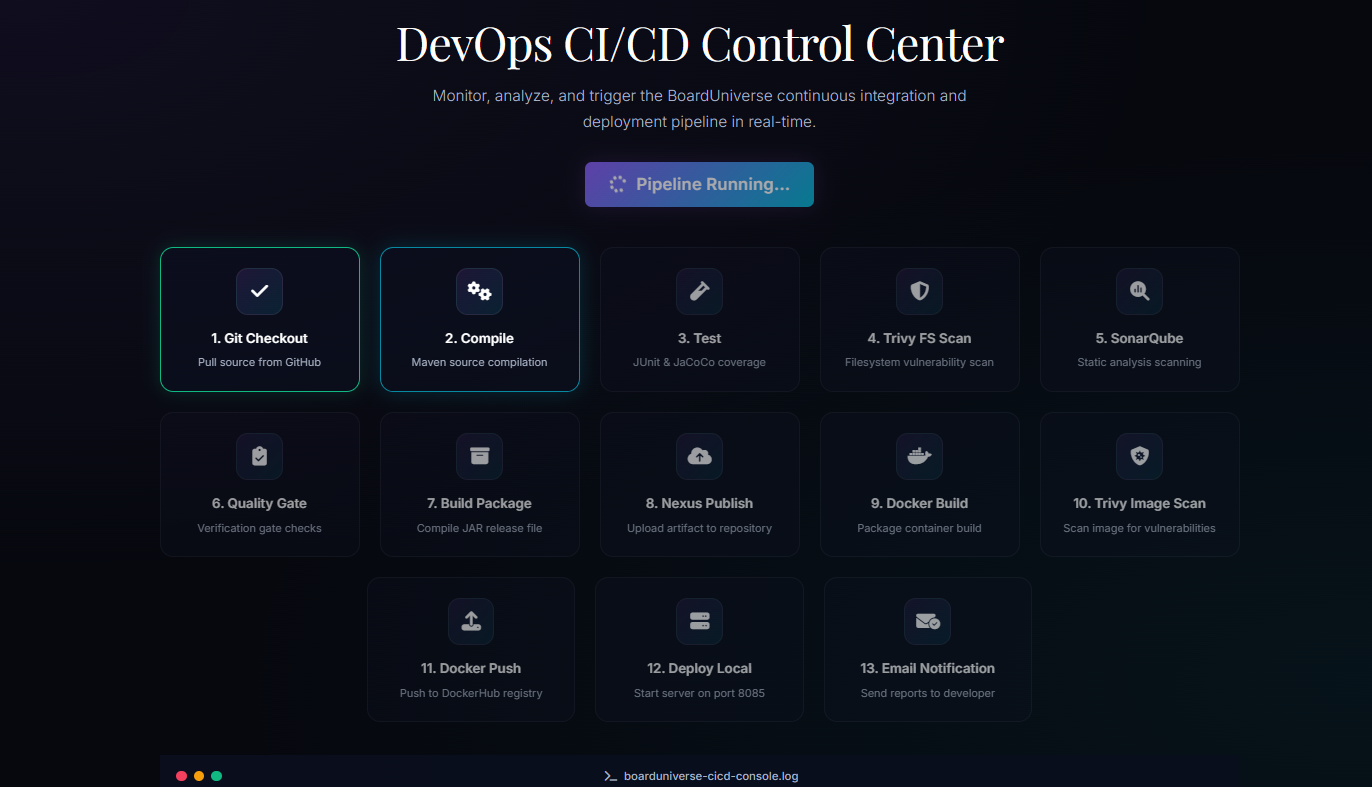
BoardUniverse
Enterprise-grade CI/CD automation platform with Docker, Jenkins, SonarQube, Nexus, and Trivy for secure, production-ready deployments.
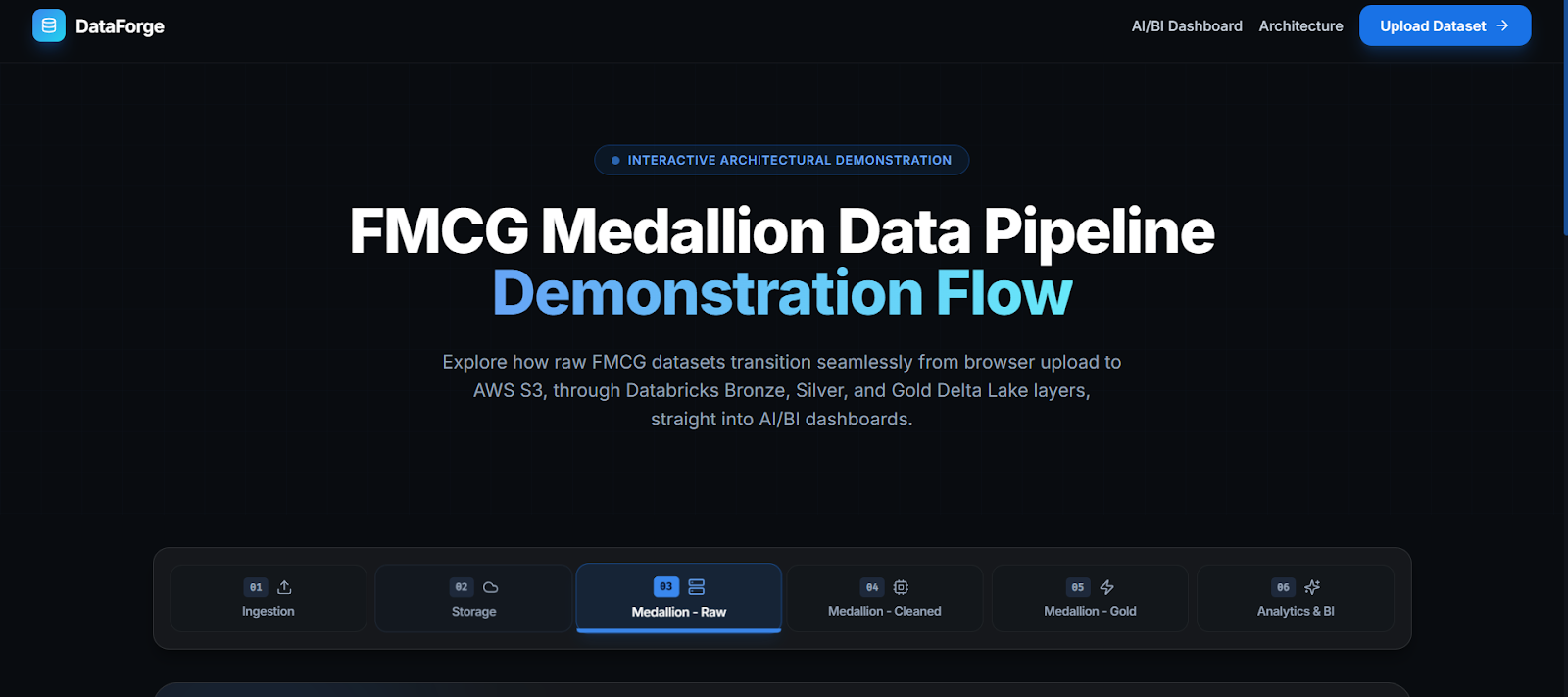
DataForge
Enterprise data lakehouse platform implementing Medallion Architecture on AWS + Databricks with real-time AI/BI dashboards.
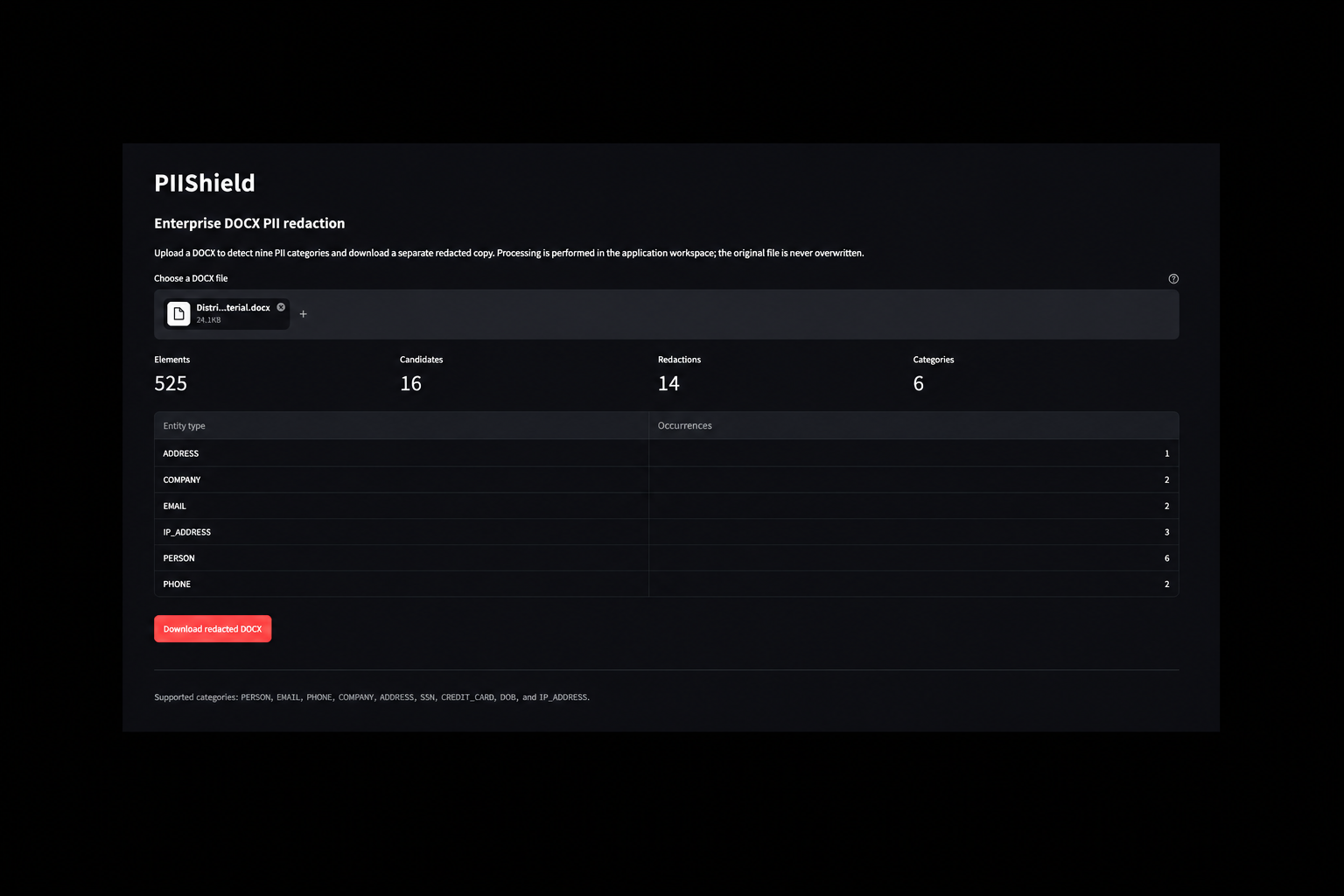
PIIShield- Enterprise PII Redaction Pipeline
An end-to-end privacy pipeline that detects, resolves, and deterministically redacts 9 categories of PII from DOCX documents while preserving document formatting and generating auditable evidence.